Before raising capital
Investors price risk. Documented capability and clear ownership of intangible assets change the conversation.

For established founders preparing to grow, raise capital, step back or sell — without the knowledge, relationships and delivery capability leaving with them.
We do not calculate valuations. We move them.
Free assessment · Immediate insight · No obligation
Built for founder-led technology, consulting, engineering, professional-services and specialist B2B businesses with valuable expertise that has not yet become fully transferable enterprise value.
Discover the diamond in your business. The High Valuation Code™ is an Enterprise Value Architecture for founder-led businesses: identify, codify, protect, commercialise and transfer the value that already exists in your expertise, relationships, processes, know-how and systems.
~30 years
in finance, valuation, M&A and board-level work
Blue-chip, scale-ups, turnarounds
experience across all three
$480m+
in transaction experience
22,000+
newsletter readers
Author of Fail. Pivot. Scale. — 5.0/5 from 21 global Amazon ratings.
If knowledge, relationships, decisions and delivery remain dependent on the founder, buyers and investors see risk — even when revenue and profit look healthy.
The judgement behind excellent work has never been captured, so it cannot be taught, audited, automated or transferred.
Work waits for the founder. Growth remains limited by one person’s calendar.
Outcomes vary by person, creating rework, escalation and risk.
Customers and partners trust particular people rather than the institution.
Automation scales inconsistency when the underlying expertise and decisions have not been codified.
Revenue shows activity. Transferable capability creates enterprise value.
If the value leaves when you leave, you do not fully own the value yet.
Investors price risk. Documented capability and clear ownership of intangible assets change the conversation.
A successor can only inherit what has been written down, structured and handed over.
Buyers discount businesses where the knowledge and relationships walk out with the founder.
The ceiling is usually founder capacity, not market demand.
Delegation only works once decisions, standards and judgement exist outside one head.
AI amplifies whatever it is given. Codified expertise first, automation second.
Can the business produce reliable outcomes?
Consistent delivery, forecastable revenue and results that do not depend on who happens to be on the job.
Can value move beyond the founder?
Knowledge, relationships and decisions held by the company rather than by one person.
Can the business grow without proportionally increasing founder time and complexity?
Capacity that expands through systems and people, not through longer founder hours.
Map the expertise, relationships, processes, assets and opportunities that actually create value in the business — including the ones nobody has named yet.
Transferable value is value that sits in the company’s systems, people, processes, governance, intellectual assets and revenue model — so the business becomes more predictable, transferable and scalable.
Founder-held value
Transferable business value
The High Valuation Code is an Enterprise Value Architecture and transformation process for founder-led businesses. Nothing is invented: the work is making what you already do repeatable, ownable and transferable.
A structured assessment across the drivers of predictability, transferability and scalability.
See where value is trapped, exposed or dependent on the founder.
A deeper, paid review of knowledge, intellectual property, leadership, delivery, revenue quality, commercial model, financial intelligence and AI readiness.
Turn priority findings into documented, protected and transferable capability.
Depending on the programme, outputs may include:
The High Valuation Score is the entry point. It is not a formal valuation report, and it is not a wealth-management product.
Specific to this business and its circumstances. Not a guarantee of a similar result.
Specific to this business and its circumstances. Not a guarantee of a similar result.
Specific to this business and its circumstances. Not a guarantee of a similar result.
Specific to this business and its circumstances. Not a guarantee of a similar result.
These outcomes were reported by individual businesses and arose in their specific circumstances. They are not predictions, projections or guarantees of future valuation, funding or commercial performance.
“It’s rare to find someone who balances deep technical expertise with the ability to make the complex easy to understand.”
“What stands out isn’t just his clarity of thought, but the depth behind it.”
Published professional recommendations from Matteo’s LinkedIn profile. They describe working with Matteo personally and are not an endorsement of a particular commercial outcome.
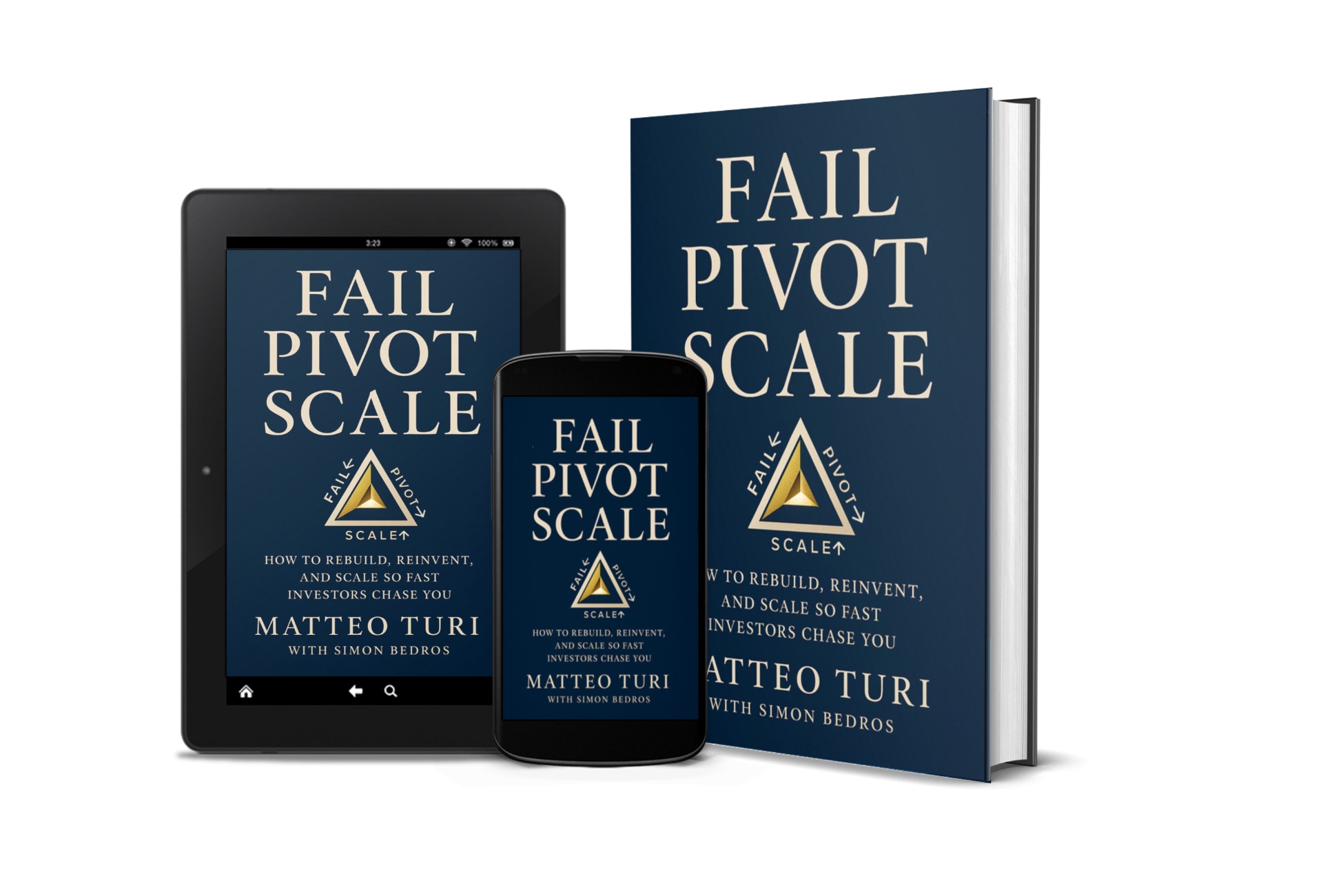
5.0/5 · 21 global Amazon ratings
Readers describe it as practical and immediately applicable, grounded in real transactions and CFO/M&A experience, and useful for founders, executives and boards — particularly on the difference between revenue growth and enterprise value, intellectual property, succession and building transferable value rather than growth at all costs.
“An evergreen operational manual” for founders, executive teams and boards, with practical self-assessment tools.
Francisco Gaffney, Board Advisor
Verified Purchase
“Good balance between depth and readability.”
Zephyr Ning
Verified Purchase
“The advice is grounded in real transactions, not recycled startup mythology.”
Tayview
Amazon reader review
“Stop chasing growth — start building real value.”
Hogie
Amazon reader review
“Practical help, not platitudes.”
Alan Carvell
Amazon reader review
“Motivational without the usual clichés, and genuinely useful.”
SJT
Amazon reader review
These are reader reviews of the book on Amazon. They are not client testimonials, and they are not an endorsement of the High Valuation Code by Amazon or by any reviewer’s employer.
In 1975, tangible assets represented 83% of S&P 500 market value and intangible assets represented 17%. By the end of 2025, Ocean Tomo reports that intangible assets represented approximately 92% of S&P 500 market capitalisation, while tangible assets represented approximately 8%.
Ocean Tomo describes this as “economic inversion” — a shift from value that can be touched to value that can be thought.
These are S&P 500 market-value figures. They do not measure every private company. They show the direction of the economy and the growing importance of knowledge, data, software, algorithms, brands, relationships, systems and know-how.
Source: Ocean Tomo, Intangible Asset Market Value StudyToo many founders are still building for an economy that ended decades ago. In 1975, intangibles represented 17% of S&P 500 market value. Today, Ocean Tomo reports approximately 92%. What will your business need to own, protect and transfer in the years ahead?
You do not need to predict the distant future. You do need to identify the intangible assets already creating value in your business, and make those assets usable, ownable, commercialisable and transferable.
The High Valuation Code builds the grid — so AI amplifies proprietary expertise instead of accelerating undocumented work or turning your advantage into commodity output.
The new electricity — abundant, cheap and available to everyone.
The generator. Your codified expertise is what produces the power.
The transformer. Depth and operating systems make the power usable.
The transmission lines. Distribution carries the value to where it pays.
The High Valuation Code builds the organisational grid so AI amplifies proprietary expertise rather than automating inconsistency or commoditising the company’s advantage.
Matteo leads the value-creation thesis. Marguerite turns it into practical transformation.

Creator of the High Valuation Triangle™ and the High Valuation Code™ · Co-author of Fail. Pivot. Scale.
Matteo is a Chartered Accountant, CFO, board director and valuation strategist with nearly 30 years of experience across blue-chip companies, scale-ups, capital raises, acquisitions and turnarounds.
His work focuses on turning intellectual property, leadership depth and scalable commercial structures into enterprise value, across technology, fintech, cybersecurity, renewable energy, medical technology and biotech.
He leads the value-creation thesis, finance, valuation architecture, strategic framing and capital perspective.

Partner and Transformation Lead
Marguerite turns the enterprise-value architecture into practical organisational change — capturing knowledge, improving handoffs, strengthening execution and creating transferable operating capability.
Specialist practitioners who extend the High Valuation Code into governance, board effectiveness and AI-enabled execution.

Board effectiveness and governance
A board governance expert with extensive experience in infrastructure, Francisco advises on board effectiveness, director dynamics and the governance structures that make enterprise value durable.

AI architecture and AI-enabled execution
Over a decade of experience in tech infrastructure, Howard designs the AI architecture and execution systems that turn captured knowledge into scalable, AI-ready operating capability.
Evidence and reported outcomes


Written testimonials coming soon.
Measure where your company is strong, where value remains dependent on you, and which structural gaps could limit growth, investment or succession.
Free · Immediate initial insight · No obligation · Not a formal valuation
Find out where it is.
Free assessment · Immediate insight · No obligation
The High Valuation Code is accepting suitable founder-led businesses into its September and October intake. We’re speaking with businesses now so the initial diagnostic can be planned properly, and the next intake will follow after that window.
The High Valuation Score is a diagnostic indicator. It is not a formal valuation report, an accounting service or a wealth-management product.
What value in my business still depends on me, and what would it take to move that value into the business?